Your free guide · England & Wales
Here’s your guide.
Here’s your personalised guide — read through, everything you need to prepare is below.
One thing before you read: you are not behind. If you weren’t the person closest to the money and the paperwork, that’s incredibly common — and it’s completely fixable.
Educational information for England & Wales — not legal advice, and not a substitute for a solicitor.
There’s something waiting for you at the end of this guide.
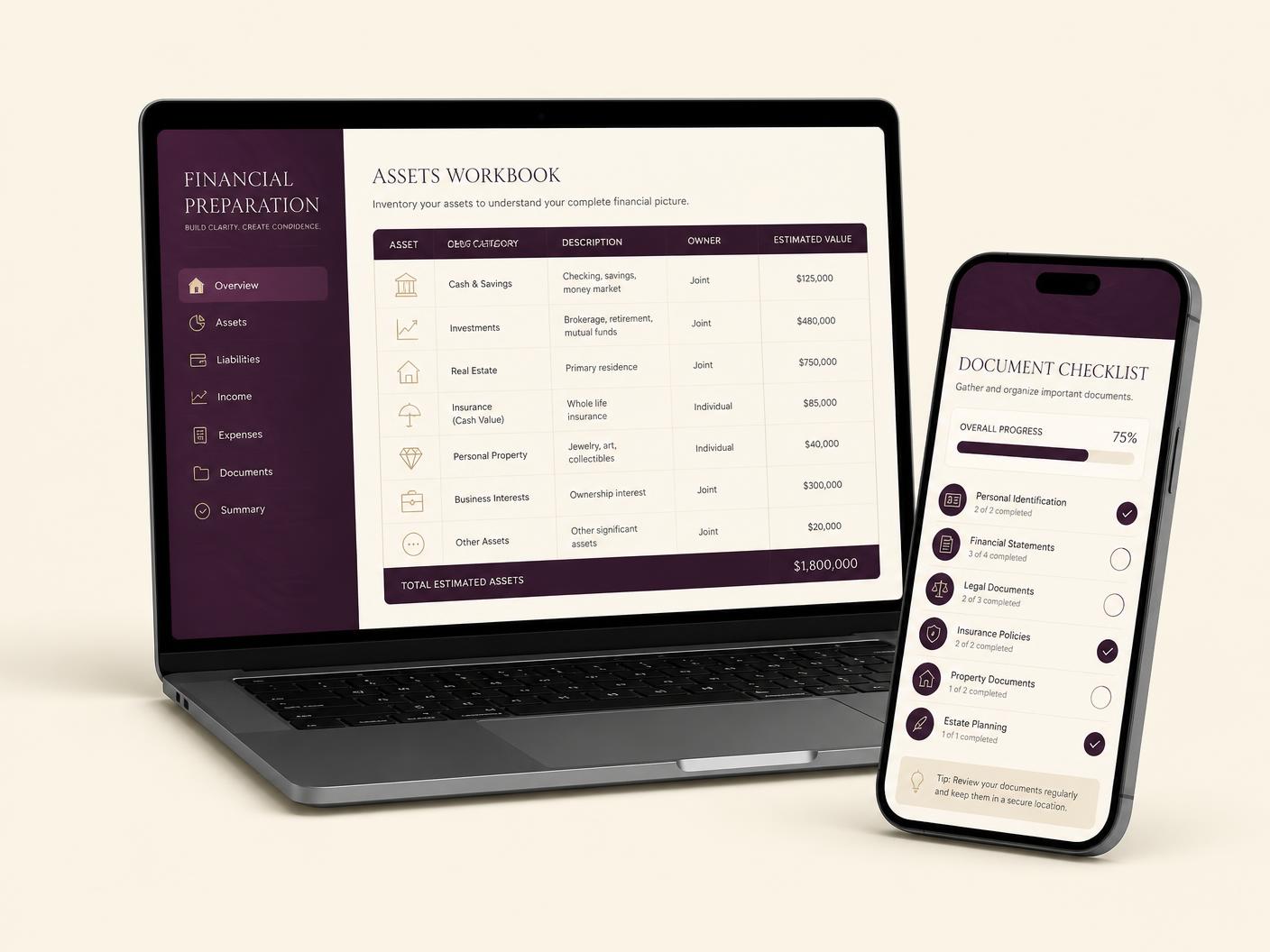
Read through first — then we’ll show you the toolkit that turns everything below into a clear, private plan you can take to a solicitor.
01 · The big one
The pension
If you take one thing from this guide, take this. Pensions are often the most valuable asset in a divorce — sometimes worth more than the family home — and they’re the single most commonly overlooked. Which? found 7 in 10 couples don’t share their pension when they separate.
Why it gets missed: it’s usually in his name, at his work, on a statement you’ve likely never seen. But a pension in his sole name is not automatically off the table. Pensions built up over the course of a marriage form part of the financial picture, and both people have to disclose their pensions honestly when finances are being sorted. The problem is simply this: nothing gets valued if nobody asks about it.
What to do now — you can start today
- Write down every pension you’re aware of — his and yours — including workplace pensions, personal or private pensions, and any from previous jobs.
- Note the provider and, if you can, the type (for example a “defined benefit”/final-salary scheme, or a “defined contribution” pot). You don’t need to understand these yet — just capture them.
- Understand there’s a formal figure called a CETV (cash equivalent transfer value) that puts a value on a pension for divorce purposes. The process will deal with getting these; your job now is just to know the pensions exist so none is missed.
- Ask your solicitor how the pensions will be valued, and whether options like pension sharing or offsetting are relevant to your situation. Don’t try to decide this yourself — just make sure it’s on the table.
02 · What you can see
The family home
The home is the asset you can see, so it’s where most of the emotion goes. Where you actually stand depends on more than whose name is on the deeds — it depends on the wider financial picture, everyone’s needs (especially any children’s), and what’s fair overall.
The single most useful thing you can do is get the home onto one page: value, mortgage, the equity between them, whose name it’s in, and which document proves each figure. That page alone saves you paying someone to assemble it.
What to gather now
- The current mortgage statement (balance outstanding).
- A rough idea of the property’s value — a free online estimate is fine to start.
- Whose name or names the property and mortgage are in.
- Any other property or big assets — a second property, vehicles, business interests, valuable contents.
03 · Your number
The money: your real monthly number
At some point you’ll be asked what you need to live on. Most people have never actually worked it out — and under pressure they guess low, which helps no one.
You’re aiming for one honest monthly figure and the annual figure behind it. That number is one of the most important things you’ll bring to any conversation — and it’s far better to arrive with it than to build it on the spot.
Do this now, honestly
- List your current household outgoings — housing, utilities, food, transport, children, everything.
- Then sketch what those costs look like if you were running your own household.
- Separate out the children’s costs so they’re visible.
04 · Your quick win
The documents to gather
Walking in with the paperwork already gathered is the fastest way to make an hour of advice go three times further. Start collecting these into one folder — physical or a folder on your phone.
You won’t have all of it today. That’s fine — the value is in having a single list and ticking it off, so nothing is a surprise later.
The list
- Last 12 months of bank statements (all accounts).
- Most recent mortgage statement.
- Recent payslips and last year’s P60.
- Pension annual statements — his and yours, all of them.
- Savings, ISAs and investment statements.
- Credit card and loan balances.
- A rough property valuation.
05 · Before you sign
Questions to ask before you agree to anything
Two lists worth having written down. First, before you agree anything informally with your ex: has the pension been valued? (If not, nothing about “who keeps what” is settled.) Has everything been disclosed on both sides? Is “we’ll sort the pension later” hiding the biggest number in the room?
Write the answers down as you get them — memory after an emotional meeting is unreliable.
Questions to take to a solicitor
- What are the likely costs and timescales for someone in my situation?
- What do you need me to bring, and what’s the order of the process from here?
- What am I most at risk of overlooking?
06 · At a glance
The process, at a glance
In England and Wales the divorce itself and the money are handled separately. In plain terms the journey usually runs: prepare and get organised → take advice on your circumstances → apply for the divorce order → exchange financial information (disclosure) → reach and record an agreement → final order.
Most couples reach a voluntary financial agreement rather than going to court, which is generally faster, cheaper and less stressful — and a solicitor can turn that agreement into a legally binding consent order so it can’t be reopened later.
You don’t need to memorise this. You need to know that the preparation stage — the one you’re in right now — is the one that makes every later stage cheaper and calmer. Always check the current official process at gov.uk and with a qualified solicitor for your own circumstances.